
BEHIND THE SCENES
MEET TOM, CREATOR OF HELL IN THE CELL
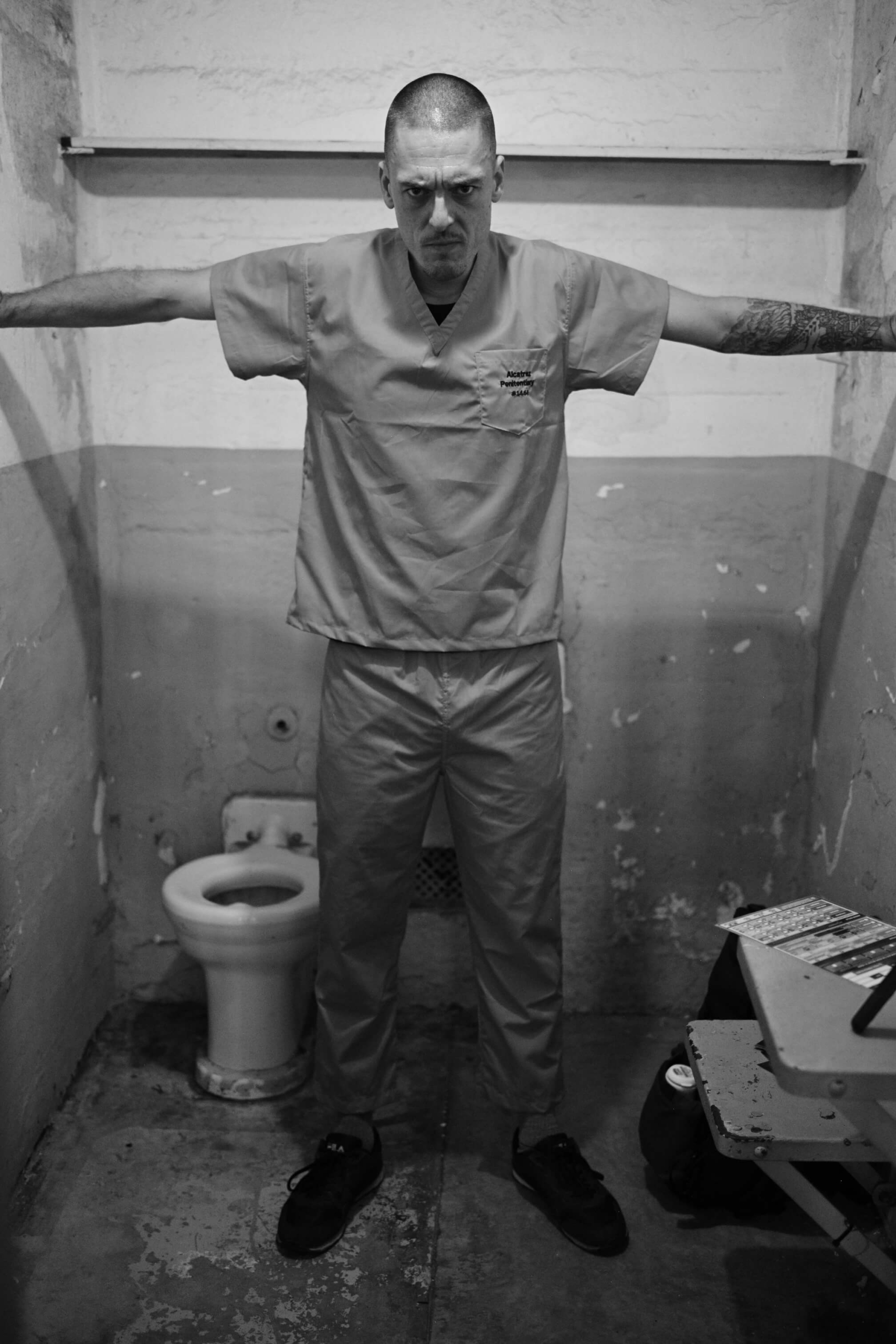
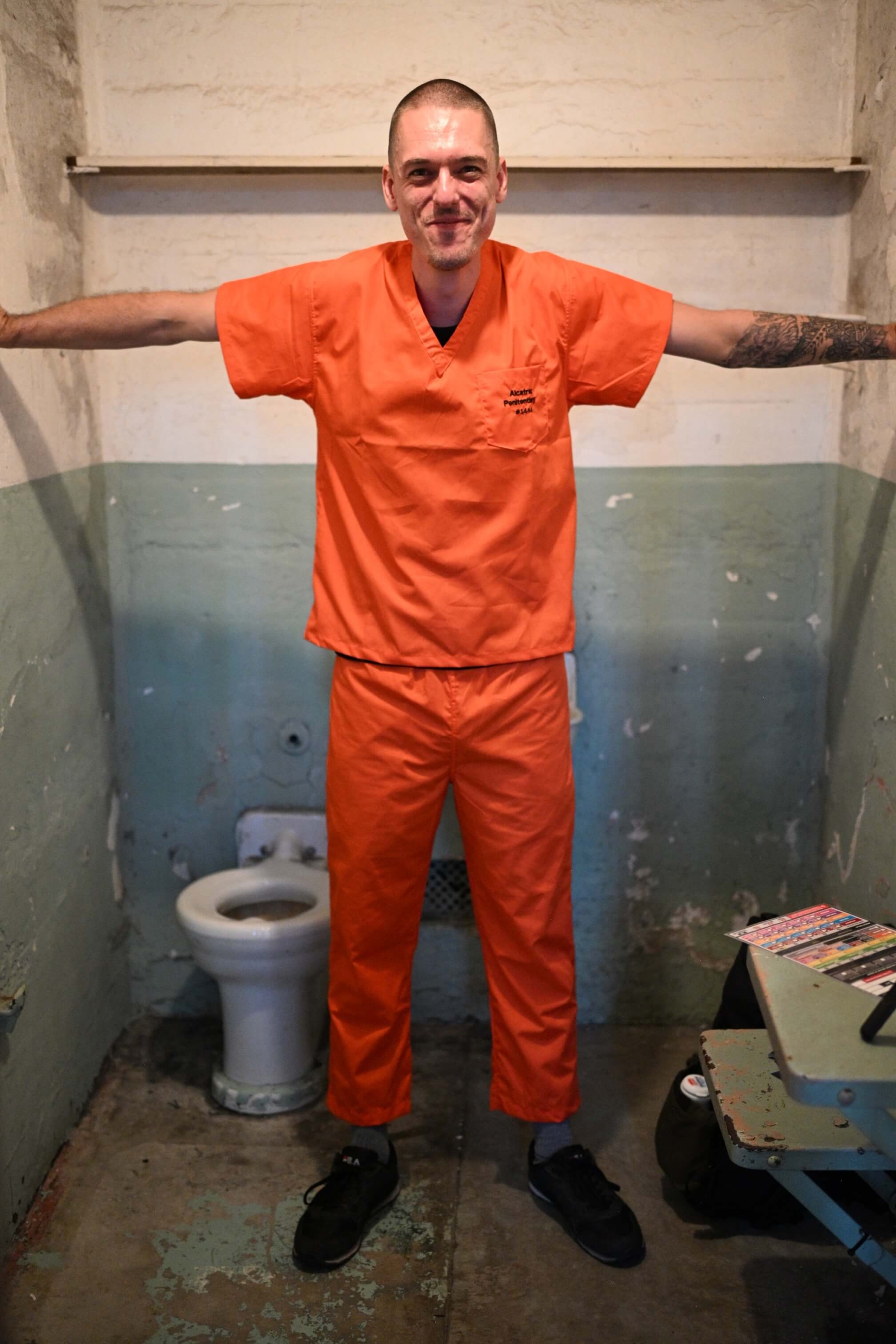
Photo taken in B Block of Alcatraz
Hell in the Cell is the first game created by Tom Humphreys, a British self-taught indie game designer currently living in Melbourne, Australia.
I’ve been designing games, worlds and gameplay mechanics inside my head for as long as I can remember, and find inspiration from basically everything. I’ve always been interested in finding new and interesting ways to have conversations about important issues – and believe games are particularly good at this.
In 2026, I worked with an incredible Success Coach, Steph, to identify the five personal values that mattered most to me. They turned out to be Creativity, Innovation, Fun, Authenticity and Justice. Which, on reflection, explains Hell in the Cell pretty well.
I’m working towards making game design a much bigger part of my life. It’s my biggest passion. Hell in the Cell is an important step towards making that happen, and the first game I’ve taken all the way from an idea to inception. It’s been a huge labour of love putting my first game together, and I truly hope everyone enjoys it.
My next projects are Feral Saints, my first videogame, a historical drama set during the Great Fire of London, and Ash of Jequitibá, a strategy game set in the Brazilian Amazon during the 1970s. These concepts also deal with issues that are incredibly important to me: wildlife conservation and protecting the natural world.
After shaving my long hair off, I do make for a convincing felon. But I’m actually a very positive and cheery person, I promise.
DEVELOPMENT JOURNEY
GAME ORIGIN
The concept for Hell in the Cell has been around on ‘Planet Tom’ for about eight years. But in early 2024, I finally decided to take it seriously and find out whether there was actually a legitimate game concept in there.
The first version existed as a handful of notes scribbled into the back of a notepad. It was originally called Felony Sweepstakes, and the basic idea was already there: ordinary people thrown into prison, forced to become increasingly terrible people to survive, then judged for everything they’d done along the way.
The original goal was to highlight a need for reform when it comes to the ridiculous and highly damaging practice of county sheriff departments throughout the United States publishing arrest records online, complete with mugshots, personal details and charges, in many cases, before there’s even been any actual convictions.
The Original “Director’s Cut” Edition of Felony Sweeptakes used this public arrest-record data to create in-game Non-Player Inmates, with the intention of having the game self-destruct by successfully spotlighting this ludicrous legal practice.
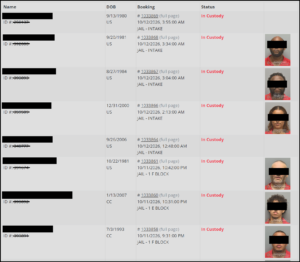
However, for legal and ethical reasons, this version of the game is simply unpublishable. I look forward to sharing more about my experiences of walking such a conflicting, creative tightrope in the future.
FROM SCRIBBLED NOTES TO PRINTED PRODUCT
The earliest versions were drawn and assembled by hand and cut out with scissors. Since then, Hell in the Cell has been through between 5-6 significant iterations, evolving into the digitally designed version you see today.
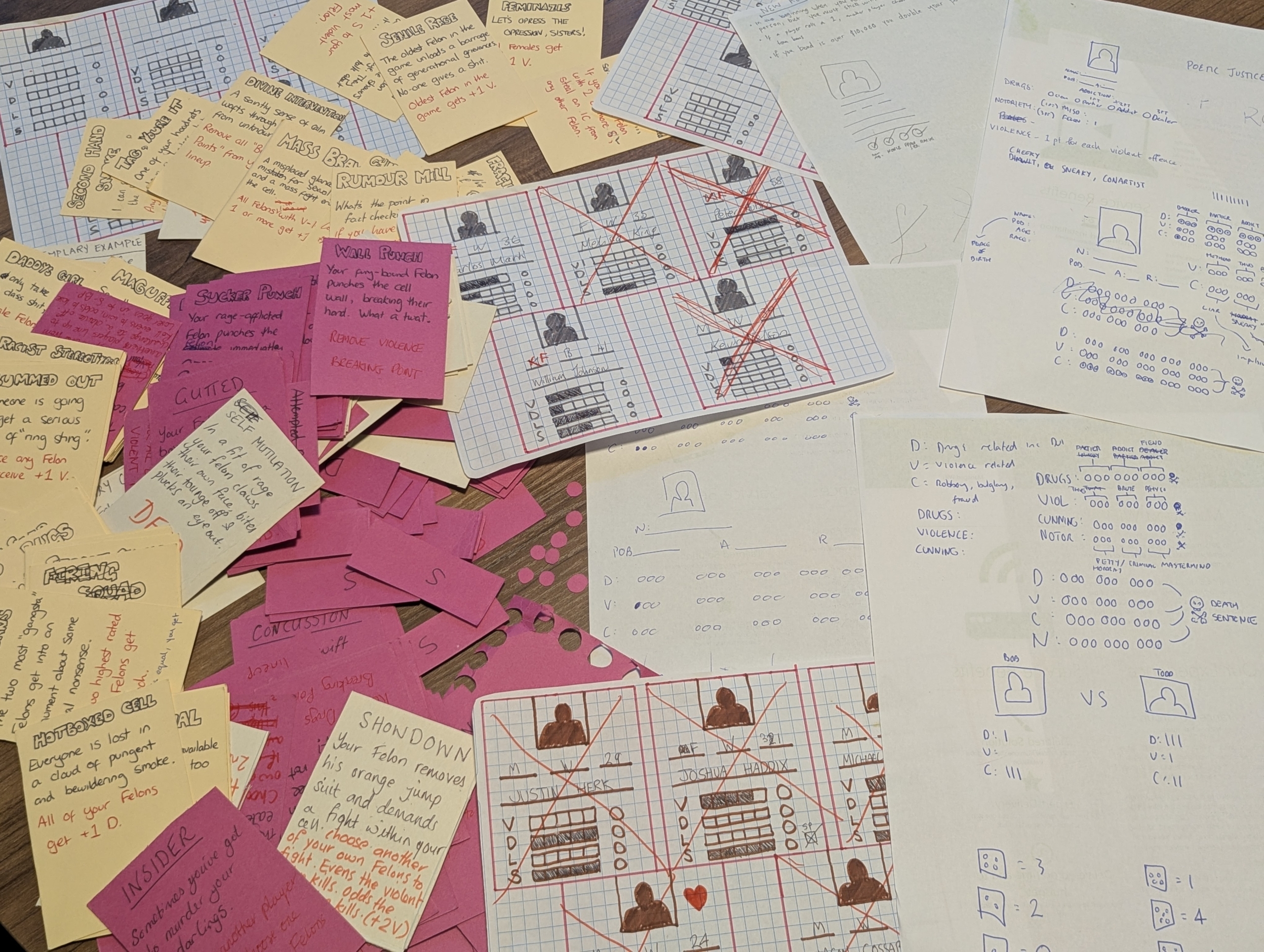
The original version of the game, back then called ‘Felony Sweepstakes’
Along the way, the game has contained all sorts of components, mechanics, rules and completely different vibes that no longer exist.
Many, many ideas I’ve had for Hell in the Cell seemed like great ideas until they were playtested. It’s been a huge journey adding, removing, combining, simplifying and balancing the DNA of the game into what I think is the leanest and most tonally correct version of Hell in the Cell.
ENSURING THE SATIRE PUNCHES ‘UP’
Through a dark-comedy lens, Hell in the Cell satirises, parodies and criticises the ways real people can be failed by the legal system, society and social media – and exposed to violence, drug addiction, psychological breakdown and other harms as a result.
One of the hardest parts of the entire development process hasn’t been mechanical.
Hell in the Cell has proven to be a challenging concept for plenty of people I’ve shared it with – especially the earlier versions of the game. And I completely understand. It deliberately ‘plays’ with subjects that are uncomfortable, sensitive and very real to a lot of people. I’ve tried to take those reactions seriously rather than dismissing them simply because they weren’t what I wanted to hear.
Real-life inmates featured much more directly in early versions of Hell in the Cell, and working out what place – if any – real people’s experiences should have in a dark comedy game has been a colossal and hugely challenging creative journey of its own. The way they’re represented has changed significantly as I’ve thought harder about what the game is actually trying to criticise, who the joke should be aimed at, and where satire stops being meaningful and starts simply exploiting the people it’s supposedly talking about.
That process ultimately helped establish one of the most important principles behind the version of Hell in the Cell that exists today: the inmates aren’t the joke. The System is.
DESIGN PHILOSOPHY
A huge part of that process has been trying to find the right balance between fun and meaning. Hell in the Cell is a game first. I want people laughing, screwing each other over, making terrible decisions and coming away with ridiculous stories about what happened to them in prison. I don’t want the satire to turn playing it into a dull, depressing lecture. Or likewise, a corny and preachy means of whinging about societal issues.
At the same time, I don’t want the darker subject matter to exist purely for shock value. I’ve worked hard to make sure there’s something underneath the outlandish humour and shocking content – that the mechanics, writing and satire actually have something to say about incarceration, prejudice, stereotyping, addiction and the way people are judged.
Beneath the gameplay, Hell in the Cell is about what happens when innocent people are incarcerated for ridiculous reasons and forced to embrace criminality to survive. And how real people fall victim to marginalisation, prejudice and stereotyping that changes how the world sees them – whether driven by systemic injustice and societal bias, or by online rhetoric, echo chambers, algorithm-fuelled sensationalism and snap judgements.
Through a dark-comedy lens, Hell in the Cell satirises, parodies and criticises the ways real people can be failed by the legal system, society and social media – and exposed to violence, drug addiction, psychological breakdown and other harms as a result.
Inmates, drug addiction and criminality aren’t the joke. The systems that birth them and then judge people for them are. It’s been an incredible artistic challenge walking this ethical tightrope, but I think I’ve finally landed on a format that gets this right.
PLAYTESTS
The very first playtest of Hell in the Cell took place in the back of a camper van in New Zealand with the wonderfully supportive Ash, who has the dubious honour of being the person most subjected to some of my most unhinged ideas and idea workshopping for the game, and badass Theresa B.
Since then, it’s been played in homes, hostels, Raspberry Farms, kitchen counters, bars, forests, campsites and wherever else I’ve been able to convince people to voluntarily enter prison for an evening.
Player feedback has genuinely changed the game and has made me reconsider mechanics, rewrite material, rethink how real people are represented and become much clearer about where the satire should actually be pointing. But I’ve also learned that responding to criticism doesn’t have to mean sanding away everything provocative about the original idea. I’ve held onto the core vision for Hell in the Cell while becoming much more deliberate about why something is there, who a joke is aimed at, and whether it’s actually saying what I think it’s saying.
Likewise, the earlier versions of Hell in the Cell were super clunky and overloaded with cards, components, rules and mechanics that slowed down (and sometimes stagnated) the gameplay experience, rhythm and flow. A huge part of development has been optimising the different systems by removing unnecessary admin, consolidating mechanics, and reducing the overall word count of each card. Now, turns keep moving, decisions keep coming and Players are always engaged by what’s happening – even when it’s not their turn. Hell in the Cell has become a much leaner game without sacrificing the strategy, chaos or player interaction underneath it.
And I’m hoping to have achieved my goal of a solidly mid-complexity gameplay experience (not too simple, not too complicated) that is highly replayable, and relatively deep and engaging, based on only a handful of interconnected gameplay systems and mechanics. It takes about 5 minutes to set the game up, then you’re off!
Everyone who has playtested Hell in the Cell can feature in the game as a Non-Player Inmate.
INSPIRATIONS
If I had to pick a ‘Mount Rushmore’ of games that really inspire me, they are:
-
The Warriors (2005) for its unique combination of gritty gang-based fighting, setting and gameplay with 1970s campy flamboyance, hilariously characterful dialogue and a killer disco and dark synth soundtrack. If there’s ever a remake, I have to be on the development team.
-
Elden Ring (2022) for its unapologetic and immensely immersive approach to difficulty, best-in-class world and creative character design, addictive gameplay, and uniquely disparate approach to storytelling.
-
Battlefield One (2016) for being a masterclass in multiplayer design, where every match feels like a chaotic scientific experiment of changing tactics, landscapes and micro-scenarios – all wrapped up with stunning visuals and audio design, and a huge array of era-accurate weaponry, tools and vehicles for players to use.
-
Jurassic Park: Trespasser (1998) for being incredibly technologically and mechanically brave for the time (it came out in the late 90s!), the innovation on display being something which I think is often overlooked. The artists and designers behind Trespasser were trying to push the envelope and do new things, which I respect and appreciate. And they achieved a tonne, all things considered.
-
Age of Empires II (1999) for being the ultimate strategy game, making resource management, army composition and building towns and cities endlessly replayable. I love how much strategic freedom emerges from how AoE II’s systems converge to turn every match into a little alternate history of exploration, expansion, and medieval warfare.
-
Grand Theft Auto IV (2008) for its immersive combination of gritty crime drama and dark humour, making Liberty City feel grimy, dangerous, depressing and hilarious all at once. GTA IV’s social commentary is perfectly balanced with excellent gameplay and innovation. Niko Bellic’s drama is a masterclass in storytelling.
-
Far Cry 2 (2008) for its determination to make the player actually interact with its wartorn, sub-Saharan setting – physically pulling out a map to navigate, dealing with unreliable weapons, fires spreading dynamically, and amazing Dunia-engine environmental interaction. FC2’s map maker also consumed an obscene amount of my younger years.
-
Ancestors: The Humankind Odyssey (2019) for exploring a fascinating setting and period of human history, and having the gumption to make the player genuinely figure out how to survive within it. Ancestors cleverly disassembles the conventions of player controls and ‘rewards’, asks you to actually pay attention, and interact with the world in gradually evolving ways – right alongside your lineage of chimptastic early hominids.
AI USAGE (OR LACK OF)
The inception and creation of Hell in the Cell predates the proliferation of AI. Whilst I was initially excited about how AI might be able to assist in my game development affairs, I’m glad to have found it to be a useless and frustrating creative partner.
Hell in the Cell has been independently designed and developed by yours truly, and all of the content and mechanics in the game are my own work. It’s been a labour of love and is my creative darling, and the finished result has been proudly put together through 100s of hours at my computer (shoutout to ‘Big Sledge’, my gaming PC), calloused fingers from manually cutting out cards, and thoroughly human creative endeavour along the way.
I have only used AI towards the end of the development process to help sense-check my writing and formatting across the 100s of unique cards that make up the game. All ideas, events, mechanics and social commentary are proudly my own, and when playing the game, you may notice something of an anti-AI stance…